

Extracting that vibrant flavour means balancing two thresholds at once: an exact roasting point and a stable fat emulsion. Push the roast too far and the delicate lipids oxidise, leaving a bitter, astringent finish. Stop short and the nut reads flat, easily buried under sugar and dairy. There is very little margin between the two.
The window narrows further when classical French technique meets a tropical climate. High ambient humidity is in constant tension with a pastry's structure. A praline paste or aerated mousse engineered to hold at a cool 18 degrees can soften, lose its lift, or weep once it hits Singapore's heavy air.
This guide breaks down the physics and chemistry behind the ingredient: how cultivar and fat content shape flavour, why genuine pistachio paste is so fragile, and which moisture-barrier techniques keep a finished pastry crisp. Each major decision is paired with a short Why It Works note, so the mechanics are clear before you commit an expensive bake to them.

The Raw Material
Not All Pistachios Are Created Equal
Commercial baking tends to treat pistachios as interchangeable, but origin dictates almost everything, from lipid structure to chlorophyll concentration. Sicily's Bronte pistachios grow in the mineral-rich volcanic soil around Mount Etna, a microclimate that yields a seed with complex aromatics and a vibrant emerald hue. Because those orchards are harvested only once every two years, the trees have longer to draw up nutrients, concentrating the oils into a rich, buttery profile. High-yield varieties bred for volume lack that depth, often carrying a woodier note and a pale, yellowish interior.
For context, a pistachio is roughly forty-five percent fat by weight, and nearly all of its flavour rides on those oils. That is why sourcing matters more here than with almost any other nut: there is no robust base compound to fall back on if the oils are dull or degraded.
| Attribute | Bronte, Sicily | High-Yield Commercial |
|---|---|---|
| Growing soil | Volcanic slopes of Mount Etna | Irrigated commodity orchards |
| Harvest cycle | Once every two years | Annual, optimised for tonnage |
| Flavour profile | Rich, buttery, resinous, savoury | Woodier, flatter, easily masked |
| Interior colour | Deep emerald, high chlorophyll | Pale, yellowish |
| Common shortcuts | None needed | Green dye and benzaldehyde |
Those quality gaps drive a familiar compromise: chemical shortcuts. Pure, stone-ground pistachio paste is incredibly fragile. The moment the nuts are ground, the exposed oils begin to oxidise, dulling the flavour and turning that brilliant green into a muted khaki. To hide the degradation, mass-market operations reach for artificial green dye and benzaldehyde, the synthetic compound that gives cheap almond extract its sharp, cherry-like aroma.
Genuine pistachio flavour is subtle. It develops slowly across savoury, resinous, and buttery notes, and it asks for patience rather than additives. Retaining it means skipping enhancements altogether and leaning instead on pristine sourcing and strict temperature control during processing, both of which exist to halt oxidation before it starts.
The marzipan note is a diagnostic, not a flavour. Benzaldehyde is volatile and assertive, so even a small dose dominates the palate and flattens the nuanced pistachio underneath. If almond is the first thing you taste, the oils have almost certainly been masked rather than preserved. A true pistachio reads savoury and resinous first, sweet second.
The Three Forms
How Pistachio Shows Up in Classical Pastry
Across classical work, pistachio desserts tend to take three main forms. Each one poses a different structural problem, and each is solved by managing the same variable: the nut's heavy, liquid fat.
The Modern Entremet
Layering pistachio into a multi-component entremet is a balancing act. Pure nut paste carries dense fats that can deflate a delicate mousse, so pastry chefs offset that weight with an airy, structural sponge such as a dacquoise or chiffon. The pairing delivers deep nut flavour without turning heavy or cloying. Our All-Pistachio Cake is built on exactly this principle, carrying several densities of the nut across different layers to keep the texture light and aerated.
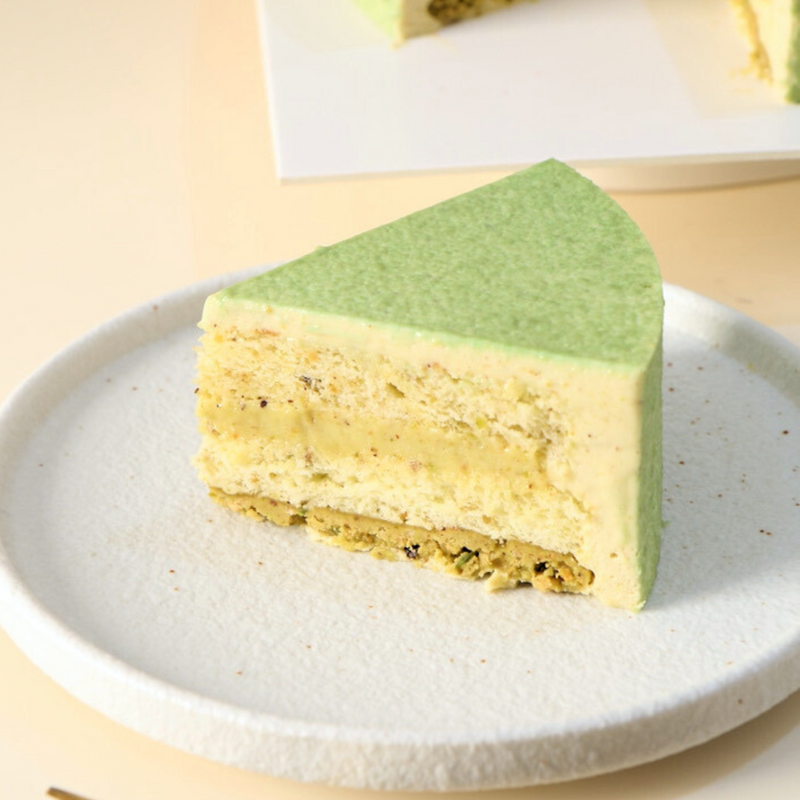
A dacquoise traps air in a stable protein-and-sugar matrix, giving the dense pistachio fats something rigid to sit against. Without that scaffold, the heavy paste compresses the mousse and the whole cake reads flat and greasy. The sponge is not a filler layer, it is the structural counterweight.
The Artisanal Tart
A tart trades on contrast: a crisp shell against a fluid, concentrated centre. A traditional pate sablee holds a layer of intense, stone-ground pistachio praline, and the whole thing lives or dies on the boundary between them. The main hazard is fat migration. If the natural oils seep into the crust, the tart loses its crunch and turns soggy from the inside out. Our broader Cakes and Tarts Collection uses exact bake times and a thin chocolate lining to keep the pastry crisp even in ambient moisture.
A brushed layer of tempered chocolate sets into a hydrophobic barrier between filling and shell. It blocks the praline's oils from wicking into the baked pastry, which is what preserves the crunch. Skip the lining and even a perfectly blind-baked sablee will soften within hours.
The Laminated Viennoiserie
Folding pistachio into laminated dough changes the chemistry of the bake. Because pistachio oil stays liquid at room temperature, adding pure paste straight into croissant or brioche dough weakens the gluten network. As it bakes, those liquid fats mix with the melting butter layers, and if the ratios are off the pastry never shatters into clean flakes, ending up greasy instead. The fix is to reduce hydration in the base dough to offset the extra oil the nut brings.
Lamination depends on distinct, alternating layers of fat and dough that steam apart in the oven. Pistachio oil blurs that boundary by softening the gluten and merging with the butter. Pulling water out of the base dough restores the contrast, so the layers stay defined and lift cleanly.
See the insulation techniques in practice.Every tart in our collection is built with the moisture barriers described above.
Browse Cakes & Tarts →Storage & Service
The Humidity Factor: Serving Fine Pistachio Desserts in the Tropics
Singapore's heat and humidity are an immediate problem for delicate pastry. The moment a cold dessert leaves the fridge, moisture from the tropical air condenses on its surface. For a pistachio creation, that film of water softens a crisp tart shell or sends a glossy glaze sliding. Keeping the dessert intact comes down to how it was stabilised against the local climate in the first place.
Many commercial kitchens lean on gelatin to set their mousses. It is cheap and forgiving, but it can turn rubbery, and it loosens toward a watery pool as it warms toward body temperature. High-end French pastry takes a different route, stabilising pistachio mousse through the cocoa butter naturally present in premium white chocolate. Cocoa butter holds its shape far better in ambient warmth and gives a clean melt that releases the nut's aroma on the tongue, rather than a bouncy, resilient chew.
Cocoa butter sets through fat crystallisation rather than a protein gel, so its structure depends on temperature control rather than a fixed melting point. A well-tempered mousse stays firm through the warm minutes between fridge and table, then yields cleanly in the mouth. Because the set is crystal-driven, precise chilling is not optional, it is the whole mechanism.
With the structure handled, service is mostly about timing the gap between the fridge and the table. Follow this short sequence and the texture holds.
- Hold cold, between 0°C and 4°C Keep the dessert refrigerated right up until you are ready to serve. This is where the cocoa butter set is protected.
- Rest 10 to 15 minutes before serving A brief window lets the cold fats and dense pistachio oils soften just enough to release their full flavour, without inviting condensation.
- Transport in an insulated bag with ice packs For any island-wide journey, keep the cold chain unbroken. Warm transit undoes everything the kitchen built in.
- Limit open-air exposure to under 2 hours Do not leave cakes in a hot car. Plate, photograph, and serve while the edges are still clean.


The All-Pistachio Cake
Everything above lives in a single dessert: layers of pistachio sponge, almond crunch, pistachio ganache, and pistachio mousse, made with Italian roasted pistachios. No dye, no benzaldehyde, and a cocoa-butter set engineered to survive the trip across the island. Available from $72 SGD in 6" (4-6 pax) and 8" (8-10 pax) sizes. It is the most direct way to taste the difference between real pistachio and the marzipan shortcut.
Order the All-Pistachio Cake →Good to Know
Frequently Asked Questions
How far in advance do I need to order?
Orders need to be placed at least 48 hours in advance. Same-day ordering is not available through our online system. If you have an urgent request, WhatsApp us at +65 81273925 and we will do our best to help.
How should I store the cake after delivery?
Keep the cake refrigerated at 0-4°C. Our products are best eaten fresh on the day of delivery, as they are baked fresh and contain dairy, egg, and fruit. Do not leave the cake outside for more than 2 hours, and do not leave it in a hot car.
What is the delivery fee?
Delivery is $15 per location. Orders above $150 qualify for free delivery to one location. We deliver islandwide across Singapore, with a small number of exceptions. See our FAQ page for the full list of areas we are unable to reach.